

“The heavyweight battle of the decade is no longer happening in a boxing ring—it’s happening in your local pharmacy. Mounjaro vs. Wegovy: two clinical titans promising to erase decades of weight struggles with a single weekly shot. But with price tags that can rival a mortgage payment and biological mechanisms that differ more than you think, choosing the wrong one could mean wasting months of time and thousands of dollars. Which one actually delivers the ‘knockout’ punch for your metabolism?”
Intro
In the rapidly evolving world of metabolic medicine, Mounjaro vs. Wegovy has become the most debated comparison among American patients and healthcare providers. While both are FDA-approved, once-weekly injectable medications designed for significant weight loss, they are far from identical. Wegovy, the pioneer, paved the way with its GLP-1 technology, but Mounjaro has recently surged ahead in clinical popularity by adding a second hormonal pathway. This guide provides a deep dive into the clinical efficacy, real-world costs, and insurance hurdles of both medications in 2026.
Summary
Mounjaro (tirzepatide) and Wegovy (semaglutide) are both injectable medications used for chronic weight management. The primary difference is that Wegovy mimics one hormone (GLP-1), while Mounjaro mimics two (GLP-1 and GIP), typically leading to 5-7% more total weight loss. As of 2026, both list for around $1,050–$1,350 per month in the U.S., though Mounjaro often shows superior results in “head-to-head” trials. Choosing between them usually depends on your specific insurance coverage and how your body tolerates gastrointestinal side effects.
Mounjaro vs. Wegovy: The Battle of the Biology
To understand the Mounjaro vs. Wegovy debate, you must understand how they talk to your brain.
- Wegovy (Semaglutide): This is a selective GLP-1 receptor agonist. It mimics the GLP-1 hormone that your body naturally releases after eating, which tells your brain you are full and slows down your stomach’s emptying process.
- Mounjaro (Tirzepatide): This is a “dual-agonist.” It mimics GLP-1 but also adds a second hormone called GIP. This second pathway is thought to improve how your body breaks down sugar and fat, while also potentially dampening some of the nausea caused by the GLP-1 component.
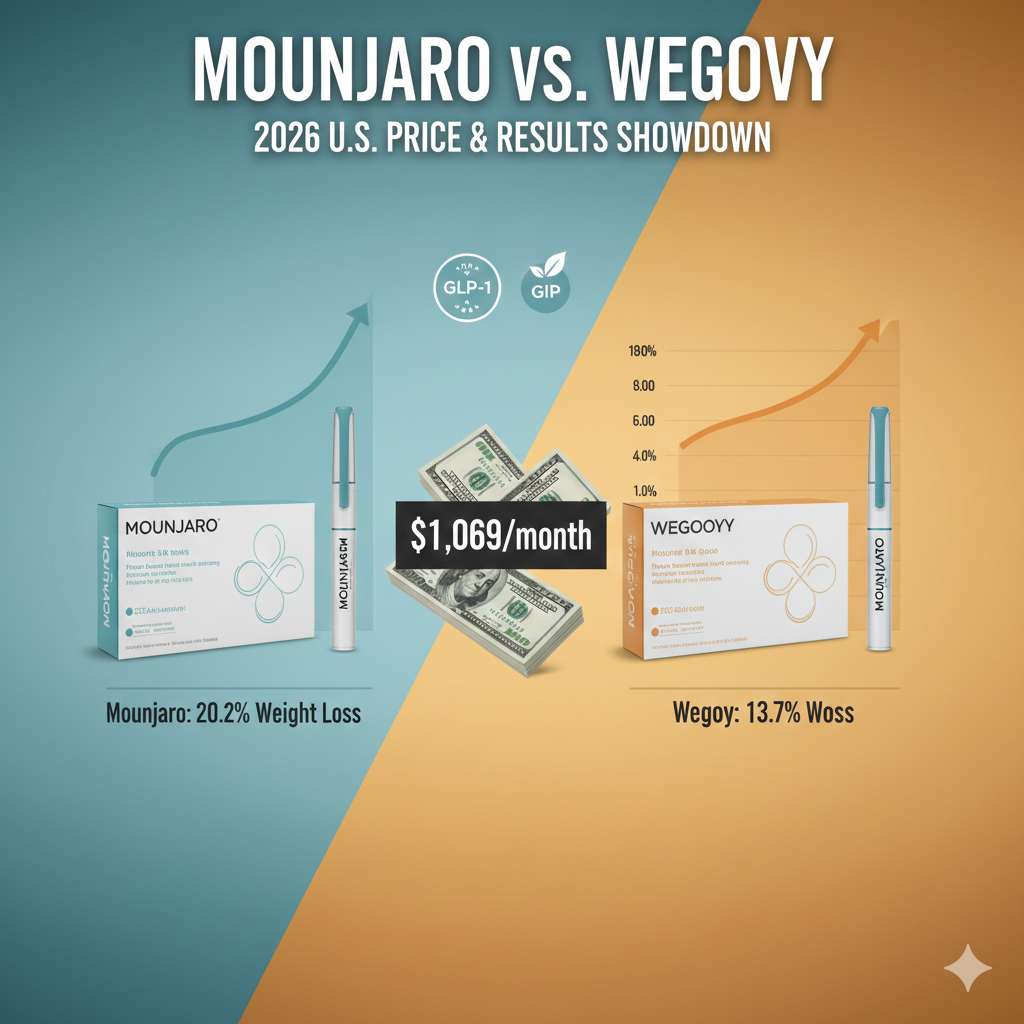
In the landmark SURMOUNT-5 head-to-head trial released in late 2024, Mounjaro users lost an average of 20.2% of their body weight, compared to 13.7% for Wegovy users over the same 72-week period. Technical details on these hormonal pathways can be explored further on the National Institutes of Health (NIH) database.
2026 Price Comparison: Out-of-Pocket Costs in the U.S.
When comparing Mounjaro vs. Wegovy, the “sticker shock” is often the deciding factor for American patients. Both drugs have high list prices, but the availability of savings programs differs.
| Feature | Mounjaro (Tirzepatide) | Wegovy (Semaglutide) |
| List Price (Monthly) | ~$1,069 | ~$1,349 |
| With Savings Card | ~$550 (if insurance denies) | ~$650 (if insurance denies) |
| Medicaid/Medicare | Often covered for Diabetes | Coverage varies by state/plan |
| 2026 Cash-Pay Options | ~$350 via select programs | ~$350 via “TrumpRx” / Federal deals |
While Wegovy has a higher “list price,” Novo Nordisk frequently offers aggressive rebates to insurance companies to remain the “preferred” drug on many employer formularies. Using tools like GoodRx is essential to find the most current local pricing in your specific zip code.
Side Effects: Which One is Easier to Live With?
Because both drugs affect the digestive system, they share a similar list of potential side effects. However, the intensity can vary.
Common Side Effects for Both:
- Nausea and Vomiting (most common during dose increases)
- Diarrhea or Constipation
- Fatigue and “Brain Fog”
The “Dual-Action” Difference:
Some clinical data suggests that the GIP component in Mounjaro may actually help stabilize the stomach, making the nausea slightly more tolerable for some compared to high-dose Wegovy. However, Mounjaro has been linked to a slightly higher frequency of gallbladder issues in some studies. As an E-E-A-T (Experience, Expertise, Authoritativeness, and Trustworthiness) best practice, always inform your doctor of any history of pancreatitis or medullary thyroid cancer before starting either medication.
Insurance Navigation: The 2026 Landscape
In 2026, the insurance market has become even more restrictive.
- Prior Authorization (PA): Almost all U.S. insurers now require a PA for both drugs. They may require proof that you have participated in a structured weight loss program for at least 3-6 months before they will pay.
- The “Comorbidity” Loophole: While many plans still exclude “weight loss,” they may cover Wegovy if you have heart disease (based on the SELECT trial results) or Zepbound (the weight-loss version of Mounjaro) if you have obstructive sleep apnea.
Which One Should You Choose?
The winner of the Mounjaro vs. Wegovy contest depends on your personal health profile:
- Choose Mounjaro if: You want the highest possible weight loss percentage and your insurance covers it (or you can afford the $550 coupon price). It is currently the “gold standard” for sheer efficacy.
- Choose Wegovy if: Your insurance plan lists it as the “preferred” medication, or if you have a history of cardiovascular issues, as Wegovy has more long-term data regarding heart attack and stroke risk reduction.
- The “Switch” Strategy: Many Americans start with Wegovy and “switch” to Mounjaro if they hit a weight-loss plateau.
Conclusion
Both Mounjaro and Wegovy are revolutionary tools in the fight against obesity. While Mounjaro currently holds the crown for the most significant weight loss, Wegovy remains a reliable, heart-healthy option with a longer track record of safety. In the U.S. healthcare system, the “best” medication is ultimately the one that fits your biology and your budget. Consult with a specialist to determine which hormonal pathway is the right key for your metabolic lock.
Q&A(FAQ)
Q1. Is Mounjaro stronger than Wegovy?
Yes, in clinical head-to-head trials, Mounjaro (tirzepatide) consistently results in more weight loss (approx. 20%) compared to Wegovy (approx. 14-15%) over the same period.
Q2. Can I use Mounjaro for weight loss if I’m not diabetic?
In the U.S., Mounjaro is FDA-approved for diabetes. However, the exact same drug is sold under the brand name Zepbound for weight loss. Doctors can prescribe Mounjaro “off-label” for weight loss, but insurance is less likely to cover it without a diabetes diagnosis.
Q3. Why is Wegovy more expensive than Mounjaro?
Wegovy’s list price is higher partly because it was the first to market for weight loss and has extensive data on cardiovascular benefits. However, with manufacturer coupons, the out-of-pocket cost for patients is often very similar.
Q4. How do I switch from Wegovy to Mounjaro?
You must consult your doctor. Typically, you need to wait at least 7 days after your last Wegovy dose. Depending on your current Wegovy dose, your doctor may start you at a mid-level Mounjaro dose or have you start over at 2.5mg to avoid severe stomach upset.
Description
- Mounjaro vs. Wegovy: Which one wins? Compare 2026 U.S. prices, insurance coverage, and clinical weight loss results to find your perfect metabolic match.
- Thinking of switching from Wegovy to Mounjaro? Read our 2026 guide on the differences in side effects, costs, and why Mounjaro is leading in weight loss percentages.
- Mounjaro or Wegovy? Get the facts on the two most powerful weight loss drugs in the U.S. Learn how to navigate insurance and which one is right for your BMI.
- Head-to-head weight loss percentage chart for Mounjaro vs Wegovy
- Comparison of Mounjaro and Wegovy injection pens and 2026 pricing
- Infographic showing GLP-1 and GIP hormone receptors for Mounjaro vs Wegovy
Focus Keyword
- Mounjaro vs Wegovy
- Weight loss injection comparison
- Mounjaro vs Wegovy cost 2026
- Tirzepatide vs Semaglutide
- Best drug for weight loss 2026
- Insurance coverage for Wegovy and Mounjaro