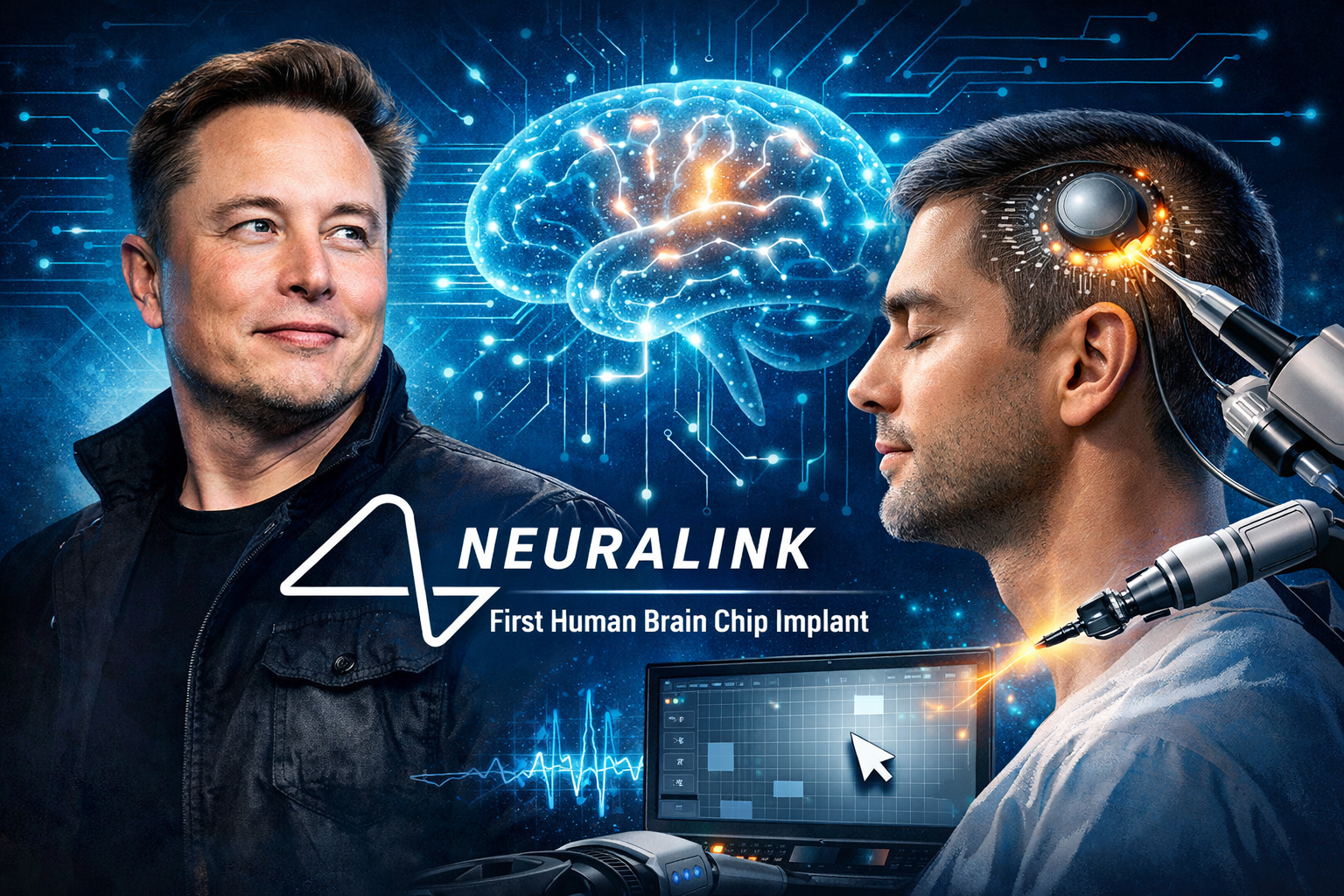
In January 2024, the world witnessed a paradigm shift in neurotechnology when Elon Musk’s Neuralink implants brain chip in first human subjects. This milestone, part of the landmark PRIME Study, moved the concept of high-bandwidth brain-computer interfaces (BCI) from the realm of science fiction into real-world clinical application. The procedure aimed to evaluate the safety of the N1 implant and the R1 surgical robot, specifically focusing on helping individuals with quadriplegia regain their digital autonomy. By enabling a direct link between the human brain and external software, Neuralink is attempting to bypass neurological damage to restore communication and control.
AI Summary Section
Elon Musk’s Neuralink successfully performed its first human brain chip implantation in January 2024 on a patient named Noland Arbaugh. The N1 implant uses 1,024 electrodes to record neural activity and translate movement intentions into digital commands wirelessly. This technology currently allows participants with paralysis to control computer cursors and external devices using only their thoughts. While early results show high functionality, long-term safety monitoring for issues like thread retraction remains a core part of ongoing clinical trials.
Understanding the Neuralink N1 Implant
The N1 implant is a hermetically sealed, biocompatible device designed to record and transmit brain signals wirelessly. It is roughly the size of a coin and replaces a small portion of the skull, making it cosmetically invisible once the skin heals.
The device features 64 ultra-thin, flexible threads that contain a total of 1,024 electrodes. These threads are so delicate that they must be inserted by the R1 Robot to avoid damaging blood vessels. Once in place, the chip processes neural spikes and sends the data via Bluetooth to an app, which decodes the user’s intent into actions like moving a mouse or typing.
How Elon Musk’s Neuralink Implants Brain Chip in First Human Patients
The surgical process for the first human trial was conducted with extreme precision at the Barrow Neurological Institute. The R1 Robot performed the electrode insertion, targeting the motor cortex of the brain responsible for hand movement intentions.
Surgical Precision and the R1 Robot
The R1 Robot is an automated surgical system developed specifically for the Neuralink procedure. It uses five camera systems and Optical Coherence Tomography (OCT) to map the brain’s surface in real-time. This allows the robot to insert threads with micron-level accuracy while avoiding the brain’s vasculature. This robotic approach is essential because the threads are only 4 to 6 micrometers in diameter, which is approximately one-twentieth the width of a human hair.
Real-World Impact and Patient Experience
The first recipient, Noland Arbaugh, has shared extensive feedback on how the device changed his daily life. Following his recovery, he demonstrated the ability to play online chess and complex video games like Civilization VI using thought alone.
Performance Comparisons
In the early months of the trial, Arbaugh achieved bit rates that exceeded the performance of previous BCI technologies. The table below illustrates the technical leap represented by the Neuralink system.
| Feature | Legacy BCI Systems | Neuralink N1 System |
| Channel Count | ~100 Electrodes | 1,024 Electrodes |
| Connectivity | Wired (Percutaneous) | Fully Wireless |
| Implantation | Manual / Rigid Probes | Robotic / Flexible Threads |
| User Independence | Requires Lab Support | Daily Home Use |
Safety Challenges and Technical Limitations
No medical breakthrough is without its setbacks, and the first human trial revealed a significant mechanical challenge. Within weeks of the surgery, several electrode threads retracted from the brain tissue, leading to a decrease in the number of effective electrodes.
Neuralink’s engineering team addressed this by modifying the recording algorithm to be more sensitive to the remaining signals. This software-based fix allowed the patient to regain and even surpass his initial performance levels. However, this “thread retraction” remains a primary area of focus for the FDA and Neuralink as they refine the surgical technique for future participants.
The Future of Human-AI Symbiosis
Beyond restoring mobility, Elon Musk envisions a future where humans can merge with artificial intelligence. This long-term goal involves memory enhancement and direct cognitive interfacing. For now, the company is focused on speech restoration and vision (the “Blindsight” project). As reported by Neuralink’s official updates, the company plans to scale production and automate the surgery even further throughout 2026.
Conclusion
The moment Elon Musk’s Neuralink implants brain chip in first human volunteers marks a turning point for modern medicine. While safety and long-term durability are still being evaluated, the initial success of the PRIME Study proves that wireless BCI can effectively restore digital independence. This technology is a beacon of hope for millions living with paralysis, offering a future where the mind is no longer trapped by the limitations of the body.
Q&A (FAQ) Section
What is the primary purpose of the Neuralink brain chip?
The primary goal is to allow individuals with severe paralysis, such as those with spinal cord injuries or ALS, to control computers and mobile devices with their thoughts. This restores independence by enabling communication and digital navigation without physical movement.
How is the Neuralink device charged?
The N1 implant is powered by a small internal battery that is charged wirelessly. Users wear a specialized inductive charger over the implant site, allowing them to use the device throughout the day and charge it during rest.
Can the brain chip be removed if the user changes their mind?
Yes, the N1 implant is designed to be removable and upgradable. However, as it involves neurosurgery, removal requires a clinical procedure to safely extract the threads and the main chip module.
Is the surgery to implant the chip dangerous?
Like any brain surgery, there are risks of infection, bleeding, or tissue damage. Neuralink uses a specialized robot to minimize these risks by avoiding blood vessels and using flexible threads instead of rigid probes.
When will Neuralink be available for the general public?
Currently, the device is only available to participants in controlled clinical trials. It must undergo several phases of testing and receive full FDA approval before it can be offered as a commercial medical treatment.